New project in Hampton

We have been appointed to develop a loft extension and a ground floor extension to an interesting 1930's bungalow in Hampton. More images will follow in the near future

Hampton-bungalow-front-elevation

The client, a family of three with one child, approached us in 2019 with an ambitions project for their two bedrooms bungalow in Hampton. Bungalows have always a great potential in terms of further development due to their usually very large footprint.

In this case the existing bungalow had been extended to the rear, however the extension was not heated and poorly built. Another issue is that the previous owner had not opened the original rear wall of the property and because of this, the original rooms facing the back of the property had lost views and daylight. This is a very typical scenario and we had to face similar situations in the past, for example in the case of our project for a rear extension in Kingston that can be seen here.

The project is divided in three phases that include a loft extension, a side extension and a rear extension. In these circumstances we usually suggest designing the whole project in one go and then extrapolate the various elements to be built in different phases.

In this instance the first stage will involve extending the existing roof of the property to form two or three new bedrooms and a family bathroom. The project also involves extending the existing roof through side dormers that will allow to achieve the necessary head height throughout the second floor.

Two apex windows, along with a number of skylights, will provide daylight to the new bedrooms and will be one of he features of both the front and the rear façade.

We can’t wait to show more detailed drawings and start construction of this interesting project.

Crittall style doors for a project in Hampton

We love Crittal style doors and windows. In this instance the doors were supplied by Fabco Sanctuary

hampton-extension-exterior-rear-detail.jpg

For the second time in a row we used Crittall style doors and windows supplied by Fabco Sanctuary for a project of ground floor rear extension in Hampton.

In this instance the client approached us after having seen our project for a rear extension in Teddington and asked to use the same type of doors that had been used in that instance. We were very glad to adopt the same solution for this project because we are big fans of these types of steel doors and windows that maximize daylight and views thank to their thin frames.

Crittall doors and windows have a long history in Britain. These types of steel doors and windows frames have been fabricated since the 1930’s. Crittall remains one of the most important manufacturers of these steel doors and windows, however there are several other companies that provide competitive “Crittall style” frames.

Modern thermal requirements meant a change in the design of the frame to include double glazing and thermal breaks.

Despite not being the most thermally efficient doors and windows on the market these types of frames manage to achieve levels of transmittance that are generally accepted by building control.

We feel that the industrial look of these doors and windows along with the simple lines of a minimal white flat roof extension provide character and contrast to extensions carried out for houses that date back to the 1930`s or similar period.

The project has been now completed and the final pictures can be seen here.

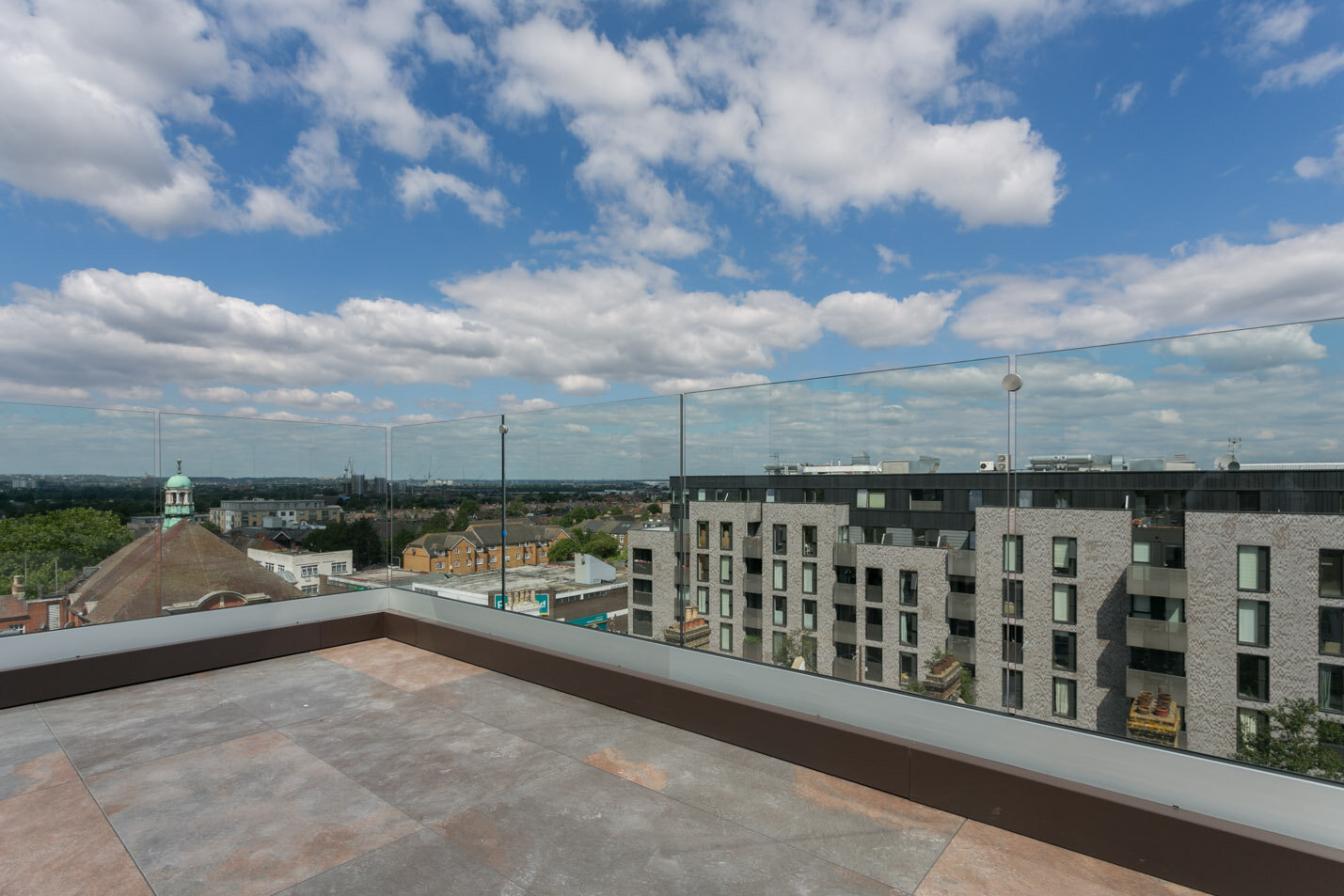
Penthouse in Walthamstow: terrace

An external view of the penthouse flat in Walthamstow. The large terrace provides great views of London

walthamstow-residential-building-external-01.jpg
walthamstow-residential-building-terrace.jpg

The penthouse for this project of a multi-storey residential building in Walthamstow represents one of the highlights of this project.

Set on the 5th and 6th floor of the building, the penthouse design was the initial reason why the client approached us in first instance.

The initial idea was for Square One Architects to be involved in the redesign of the internal layout of these two floors. With time the project scope became larger to include the other floors off the property.

Our contribution to the project included the rationalization of the internal floor plan in order to include a large kitchen and dining area, two generous bedrooms including a master bedroom and a large family bathroom.

The internal stair led to the 6th floor where the main living space of the property could be found. From here large glazed surfaces provided both daylight and access to a very spacious terrace with a glass balustrade.

The terrace looks really stunning and the views across this part of London are truly unique. You can see the rest of this project`s pictures here.

Garden office in Hampton published on Real Homes

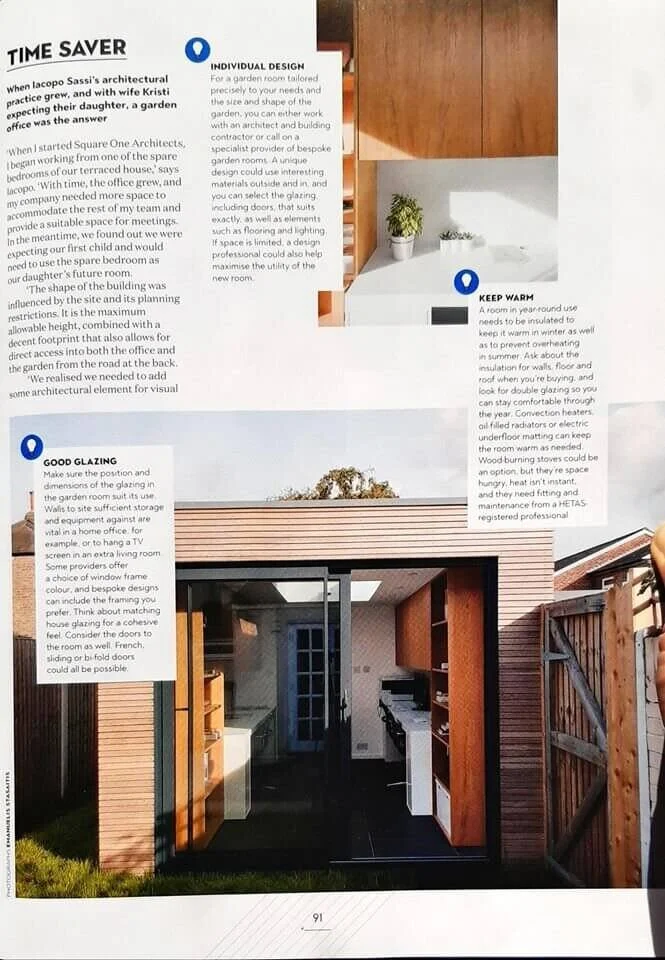
Looking back at the publication of our project for a garden office in Hampton on the July issue of Real Homes Magazine.

real-homes-magazine.jpg
real-homes-garden-office-page1.jpg
real-homes-garden-office-page2.jpg

Our project for a garden office in Hampton was published on the July 2019 issue of Real Homes Magazine.

This marks a very significant step for our firm since it is the first relevant national publication of our work.

The project of the garden office is understandably a project that is very close to our heart since it is our very own office.

The idea of having a separated building for our practice dates to 2015 when the office was founded. The idea behind this was that it would make sense to enhance our property and at the same time achieve a very practical space to carry out our operations. With many people working remotely from home I suspect that this kind of configuration will become more and more popular.

We feel that our office is much more than a traditional garden office shed and from a planning perspective, it is a very good example of what you can build under Permitted Development.

We are very happy that our project was recognized as worthy of publication. The office itself proved to be a wonderful space to carry out or work as Architects in every moments of the day. The amount of daylight received both in the morning and in the afternoon is just optimal in any season of the year and this makes us very satisfied.

In a sense we treated the office project as our very own experiment and we can say that it embodies all the qualities that we try to achieve in every project: attention to detail, materials quality and careful relationship between architecture and daylight.

The same magazine asked to publish an article for another Square One Architects projects, the house extension in East Sheen. This may follow in the next few months; we will certainly keep our blog updated!

Render vs finished product for the multi-storey residential building in Walthamstow

We always like to look back at our drawings and compare them with the finished product. In this image we put side to side a 3d render produced during the detail design phase (while we were studying with the client the best materials for the facade) and the finished building.

residential-building-walthamstow.jpg

First, a big thank you to Stefano D’Arco who produced the 3D rendering above for our multi-storey resi building project in Walthamstow. The render was successfully used by the client as both a valuable marketing and a design tool.

I always find it very interesting to compare the 3D images at design stage and the completed building photos like we did for our project of a house extension in Byfleet and New Haw that can be seen by clicking here.

In this instance the client decided to carry out some changes to the façade colours before starting construction, but the similarity between the photo realistic image and the photo is obvious. This proves that renderings can be a powerful tool to show a design to both final users and contractors in a very inspiring fashion.

At the office we are equipped with the software and skills to produce 3D models, however we tend to leave the final rendering stages to a specialist. This usually adds a small cost to the design fees (an insignificant amount in the grand scheme of things), however we feel this is always justified and can help taking some decisions at early stages that would be very costly to make during construction.

In the example above the client decided to change a dark brown paint in the middle section of the elevation for a much brighter one. It was much easier to take this decision before starting construction than asking the builder to re-paint an entire façade!

Multi-storey residential building in Walthamstow

We are excited to announce that a beautiful residential building has been finished in the lively neighbourhood of Walthamstow. This achievement is a significant milestone for the architectural landscape of the area. At Square One Architects, we were involved in designing the interiors and lighting for nine stunning flats within this building. We paid close attention to detail and focused on creating spaces that are both modern and functional. Each flat is elegant and sophisticated, with a seamless flow and a combination of natural light and carefully selected materials that enhance comfort and create a peaceful atmosphere.
Furthermore, our team has gone the extra mile to design spaces that meet the different needs and preferences of potential residents. Whether you're looking for a small and comfortable apartment or a large and luxurious penthouse, each flat provides a special and customized experience that suits modern city living. We've carefully thought about every aspect, from the modern and attractive kitchens to the lavish bathrooms, to guarantee a perfect blend of style and practicality.

residential-building-walthamstow.jpg

The photo below shows the stunning penthouse, highlighting its carefully designed interior. Every part of the space fits together beautifully to create a perfect balance between luxury and comfort. The penthouse has a calm and timeless beauty, with a consistent colour scheme and plenty of natural light flowing in through the large windows.

Below is an image of the large and stylish kitchen in the new penthouse in the neighborhood of Walthamstow. The kitchen has a modern design and appliances, making it a great place for cooking. In addition to the beautiful interior, the kitchen offers stunning views of the city and nature, creating a peaceful atmosphere while you cook. The kitchen is designed to be both practical and beautiful, making cooking a pleasant and inspiring experience for the lucky residents of the penthouse.


A-Frame house in Hampton completed

Our project for an A-Frame house in Hampton is finally completed. It was a challenging project due to the relationship between the new steel structure and the existing house, but we and the clients are very happy with the final result.

a-frame-extension.jpg

Our project for an A-frame extension to a 1930’s semi-detached house in Hampton was completed in late 2019.

During our last site visit we were very impressed by the dramatic internal volume created by the vaulted pitched roof extension and the impressive daylight intake from the gable windows, bifold doors and skylights located in both the pitched portion of the roof and the flat one.

This project presented its challenges on many levels, the first one related to planning and the second one was purely structural.

We discussed about the challenges that we encountered during the planning phase here.

From a structural perspective the project involved interconnecting the original 1930’s masonry structure of the house to the steel structure of the pitched roof extension, while at the same time opening the original rear wall of the property and the non-original rear wall of an existing flat roofed extension.

From our perspective the design of the steel beams that we received from the structural engineer had to be fully integrated within our drawings that had to consider other technical details such as insulation waterproofing etc...

In order to understand precisely how the structure would relate to any other architectural element, we used 3D models and analysed the various interconnections and this helped tremendously in informing our technical details and communicating our design intent to both the client and the contractor.

The result was well worth the effort and we are delighted to have received a very enthusiastic review from the client that can be seen on the project page by clicking here. We would like to thank all the parties involved in the project, but especially the client and the contractor for their effort into achieving this impressive internal space!

Project schedule #2 Home extension in East Sheen

 
east-sheen-extension-kitchen-03.jpg

Project Schedule

Year: 2017-2018

Location: East Sheen, London Borough of Richmond upon Thames

RIBA Design Stages: 0-5

Architect: Square One Architects

Structural Engineer: Glencross & Hudson

Building Control: Building Control Approval

The client for this project, a family of 5 with 3 small children, came to us in 2017 with a very specific brief. They had obtained planning permission using another architectural firm; however, they were not happy with the overall design.

The original project included a side extension, a rear extension and a first-floor infill extension. Despite getting planning approval for a significant additional square footage, the client was not very happy with the overall design and felt that not enough time and care had been spent in the  initial design phases (concept and schematic design) in order to agree a plan.

In this instance our first goal was to optimize the existing plan. Since the very beginning it became obvious that we would have had to go back to the planners with an amendment to the original planning application. The new plans were thoroughly discussed with the client until the layout was totally agreed.

Revised drawings were then submitted and subsequently agreed with the council. The side extension included a bedroom with a small living space and an en-suite bathroom to be used as a granny annexe for the clients’ aging parents.

The rear extension included an open plan kitchen, dining area and living space for the family.

The first-floor infill extension included a new large family bathroom (the original property was curiously lacking a shared bathroom and featured only two en-suite bathrooms).

The client also asked us to design a loft extension for the property an include a bedroom with an additional en-suite bathroom to be used by their au-pair.

The original four-bedroom house was turned into a generous 6-bedroom property with a well-proportioned family bathroom, three en suite bathrooms and plenty of open plan space to be shared with the client’s growing family. We were thoroughly pleased with the results and received a very positive feedback from the client.

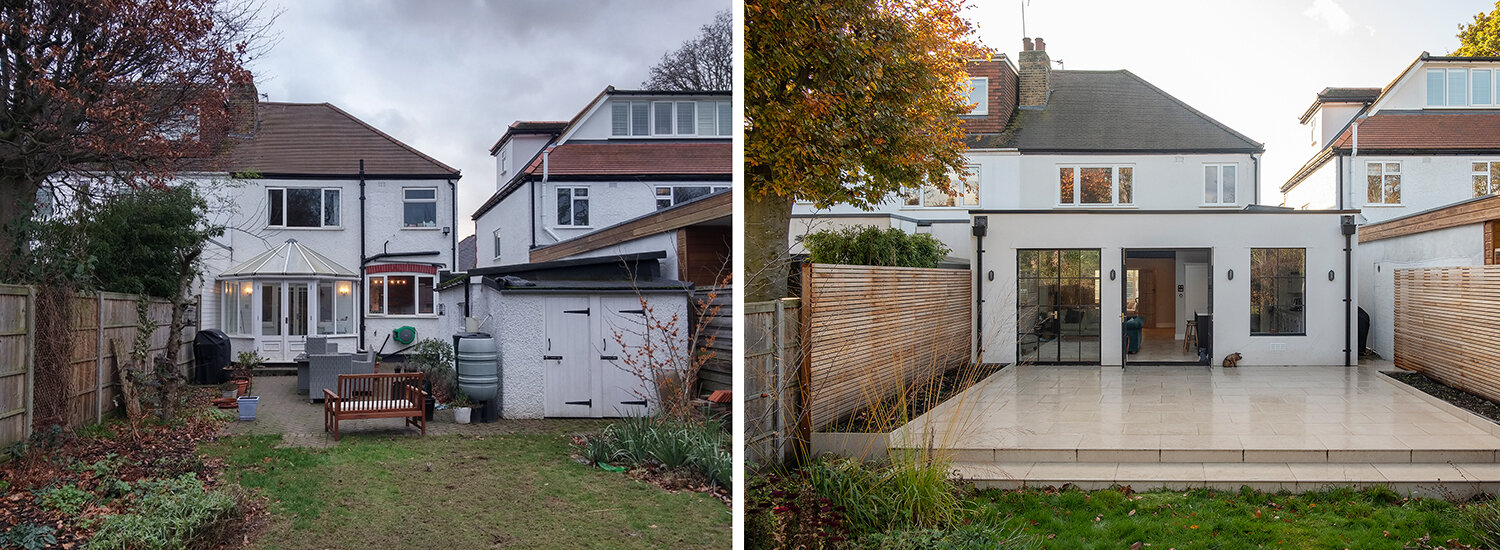
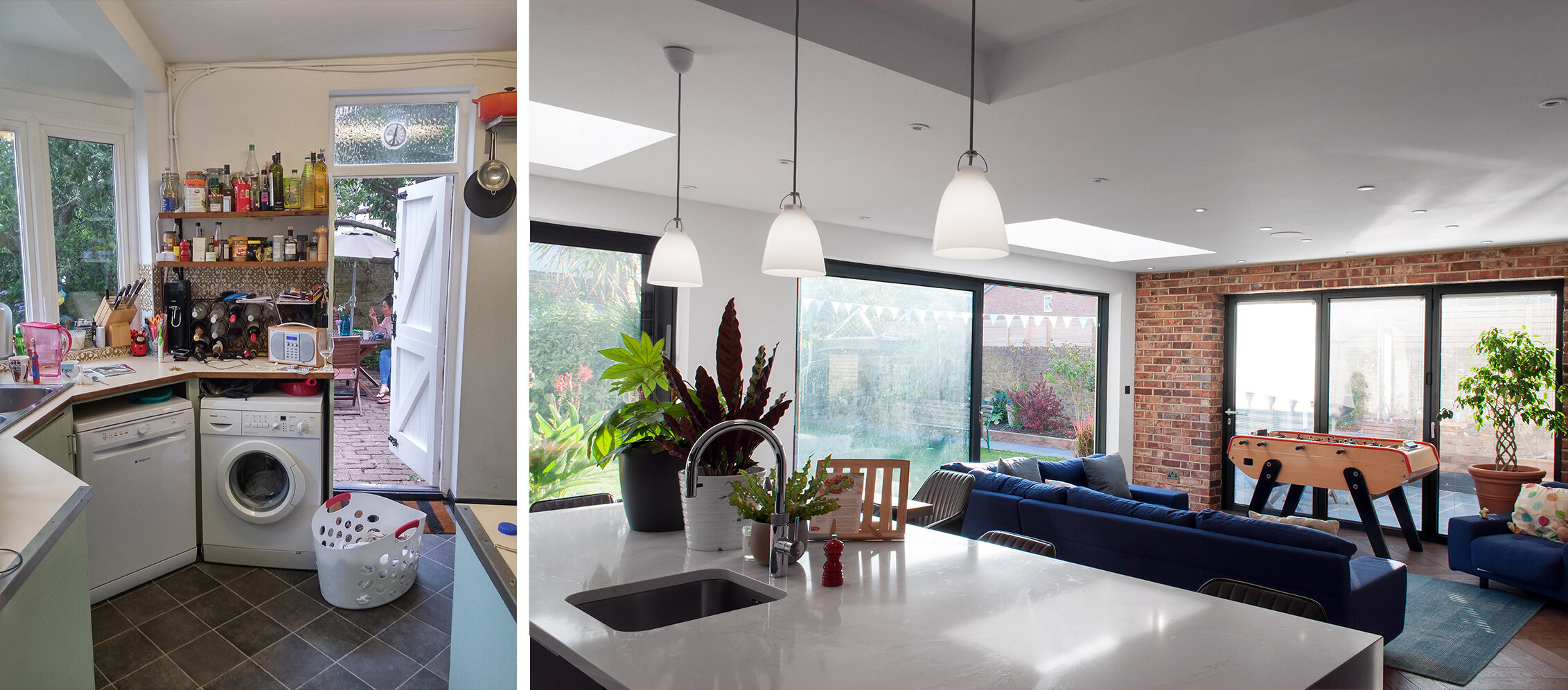
BEFORE AND AFTER IMAGES

Rear elevation

Rear elevation

Kitchen and dining area

Kitchen and dining area

Kitchen and living area

Kitchen and living area

Ground floor entrance

Ground floor entrance

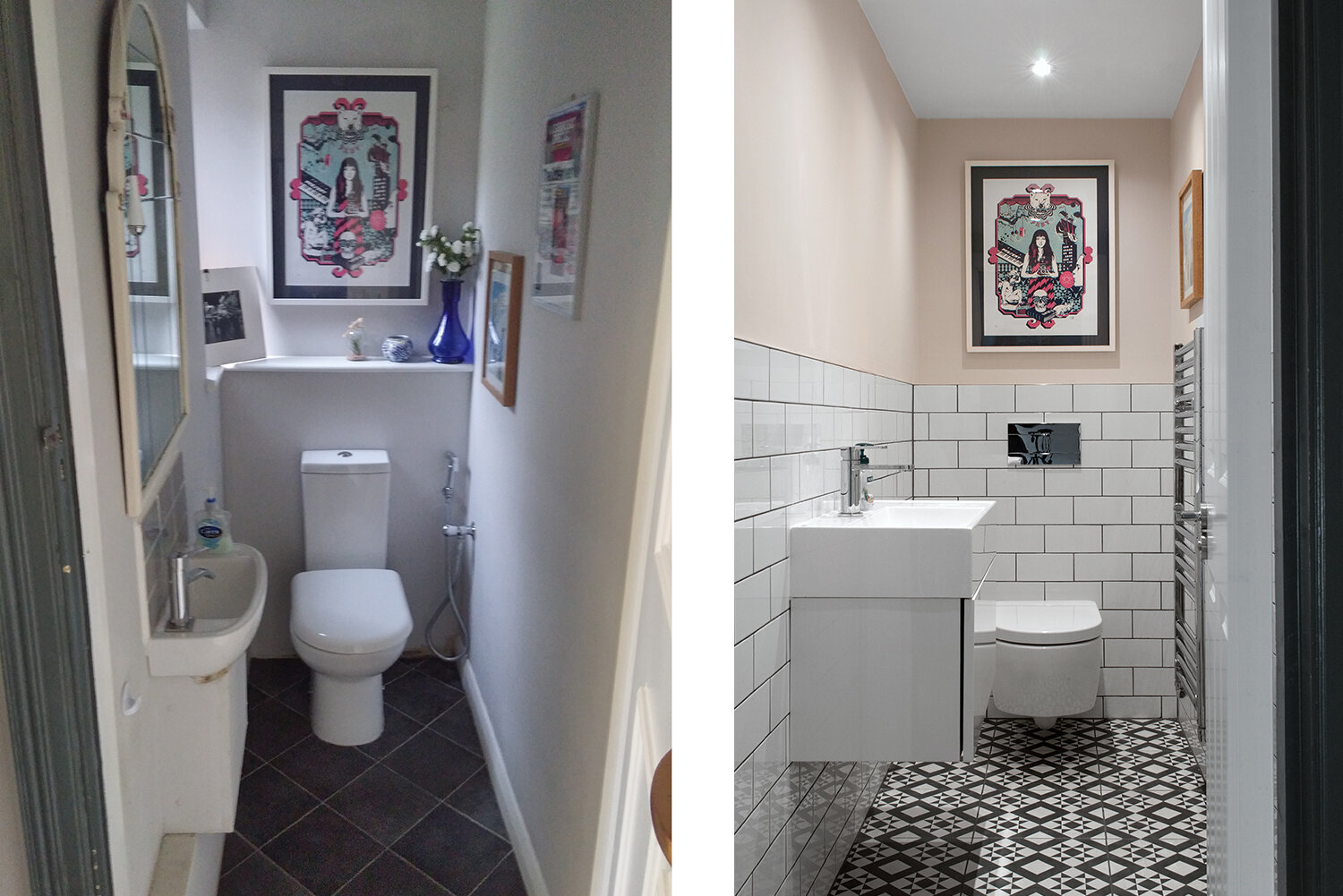
Guest WC

Guest WC

Project schedule #1 Full house refurbishment in Hampton Hill

 
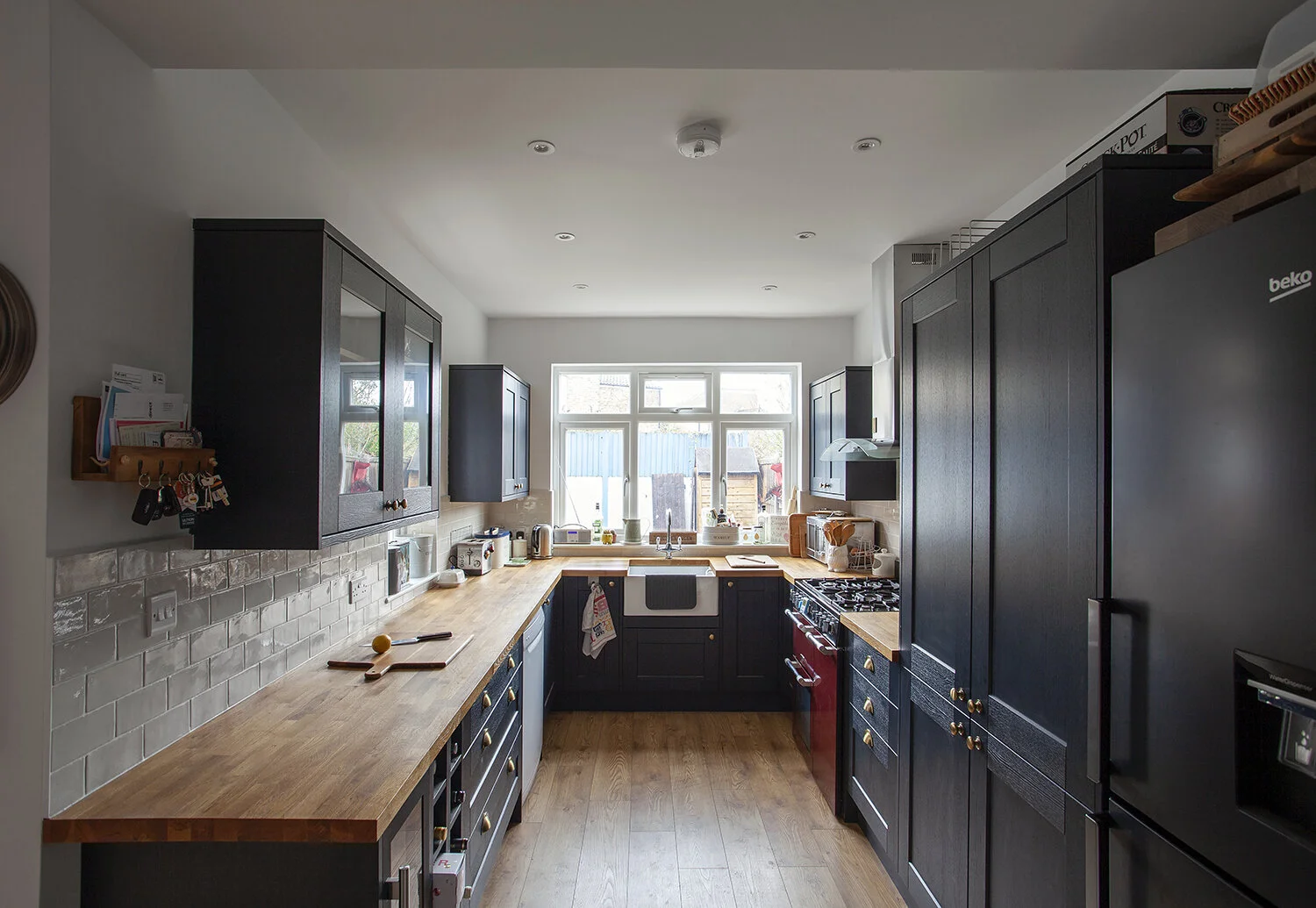
hampton-hill-kitchen.jpg

Project schedule

Year: 2017-2019

Location: Hampton Hill, London Borough of Richmond upon Thames

RIBA Design Stages: 0-5

Architect:

Square One Architects

Structural Engineer:

Glencross & Hudson

Building Control:

Building Control Approval

The client for this project approached us in 2017 with an initial briefing that included a ground floor side return extension, alterations to the existing stair and several internal alterations to the ground and the first-floor layout.

The existing property was a typical two ups two downs terraced house in Hampton Hill. The property dated back to the late XIX century and in need of renovation. During the initial phases of the design we agreed with the client to turn the original stair by 90 degrees in order to provide a more rational layout. The initial project also included a ground floor side-return extension to form a new living and dining area to the rear and large bi-folding doors.

After obtaining planning approval for these alterations the clients’ plans changed due to their personal circumstances and they decided to add a loft extension to the project.

Sudden changes in the initial brief are not unusual and we as are always happy to accommodate any additional requirement with flexibility.

The brief for the loft extension included two new bedrooms and the family bathroom with one of the bedrooms to be used as a study or guest bedroom.

A new planning approval was obtained for the loft extension and subsequently detailed drawings were produced for both tender and construction purposes.

The refurbishment was carried out within the clients’ budget with no delays, thanks to the professionalism of the contractor, but also to the clarity of our drawings and instructions.

The result is a 4-bedroom house with 2 family bathrooms and well laid out distribution spaces that benefit from additional daylight created by a skylight that was been placed on top of the new stair.

This full house refurbishment has been a great success and we are very happy that the clients, a family of two are now enjoying their extended property.

Before and after images

Ground floor kitchen and dining

Ground floor kitchen and dining

First floor bathroom

First floor bathroom

Rear view

Rear view

Loft extension in Hampton given planning approval

We recently received planning approval for a large loft extension to a detached house in a Conservation Area. These projects are always challenging due to planning constraints, but working in close collaboration with the Council can lead to a very positive outcome. We are now very excited to start the Detail Design phase, more images will follow soon!

hampton-loft-extension.jpg

The project is for a very large loft extension within a Conservation Area and as it always happens in these cases we had to go through several steps before receiving the formal approval.

The first one was to discuss the project with our clients and agree the overall design of the extension. Following this we sent the drawings to the Council to receive pre-planning application advice.

In this circumstance the pre-planning application proved to be extremely useful. We were able to engage in a very constructive conversation with the council and agree a design that would satisfy all the parties involved.

Our initial proposal was for a very modern looking loft extension including metal cladding and large doors and windows. The project also involved raising the ridge and the eaves of the existing roof.

Given the conservation status of the area we were not surprised when we received the first feedback from the council that suggested to use a more traditional language externally. We amended the proposals to include a mansard roof and smaller traditional looking dormers facing the rear of the property. We also included several roof lights that would not be visible from the street.

In the grand scheme of things this worked very well for us because we essentially achieved the same amount of space that we initially proposed. The daylight intake that we lost by reducing the size of doors and windows to the rear was regained by using skylights placed in strategic positions.

The result will be a gorgeous open space that will take advantage of a significant head height that matches the first floor of the property and very adequate daylight intake.

We can wait to see the project build and we'll update the blog in due course

Introducing the project schedules

Our client for a house extension in Twickenham recently stressed the importance of showing before and after images to highlight the impressive difference between the existing building and the extended and refurbished one. Their existing house presented some significant issues with internal steps and changes of ceiling level (a consequence of many subsequent extensions carried out in the past) and our project resolved all this issue providing at the same time an additions room.

For most projects it is important to show where you started, in order to explain in more detail the reasons behind the initial brief from the client and the subsequent decisions.

As a practice we work in a bespoke fashion for all the projects we undertake, and we place attention on the clients’ initial brief.

This gave us the idea of preparing a "project schedule" section within our blog with some key project information.

The schedules are also an opportunity to discuss the projects in a more informal way highlighting the challenges that we encountered while designing our extensions or refurbishments, but also discussing the client’s feedback and our experience working with all the other actors involved in the construction process in particular contractors, structural engineers, party wall surveyors, building control etc...

We will also discuss some planning matters, for projects that were in Conservation Areas that naturally present additional challenges.

In this sense the schedules complement the information that is already available in our projects page.

The first seven schedules are now live on our website, please click on the links below:

Schedule #1: Full house refurbishment in Hampton Hill

Schedule #2: Home extension in East Sheen

Schedule #3: Rear extension in Teddington

Schedule #4: House extension in Barnes

Schedule #5: House extension in Byfleet and New Haw

Schedule #6: Rear extension in Hampton Hill

Schedule #7 Rear extension in Hampton

Work in progress: House extension in Kingston

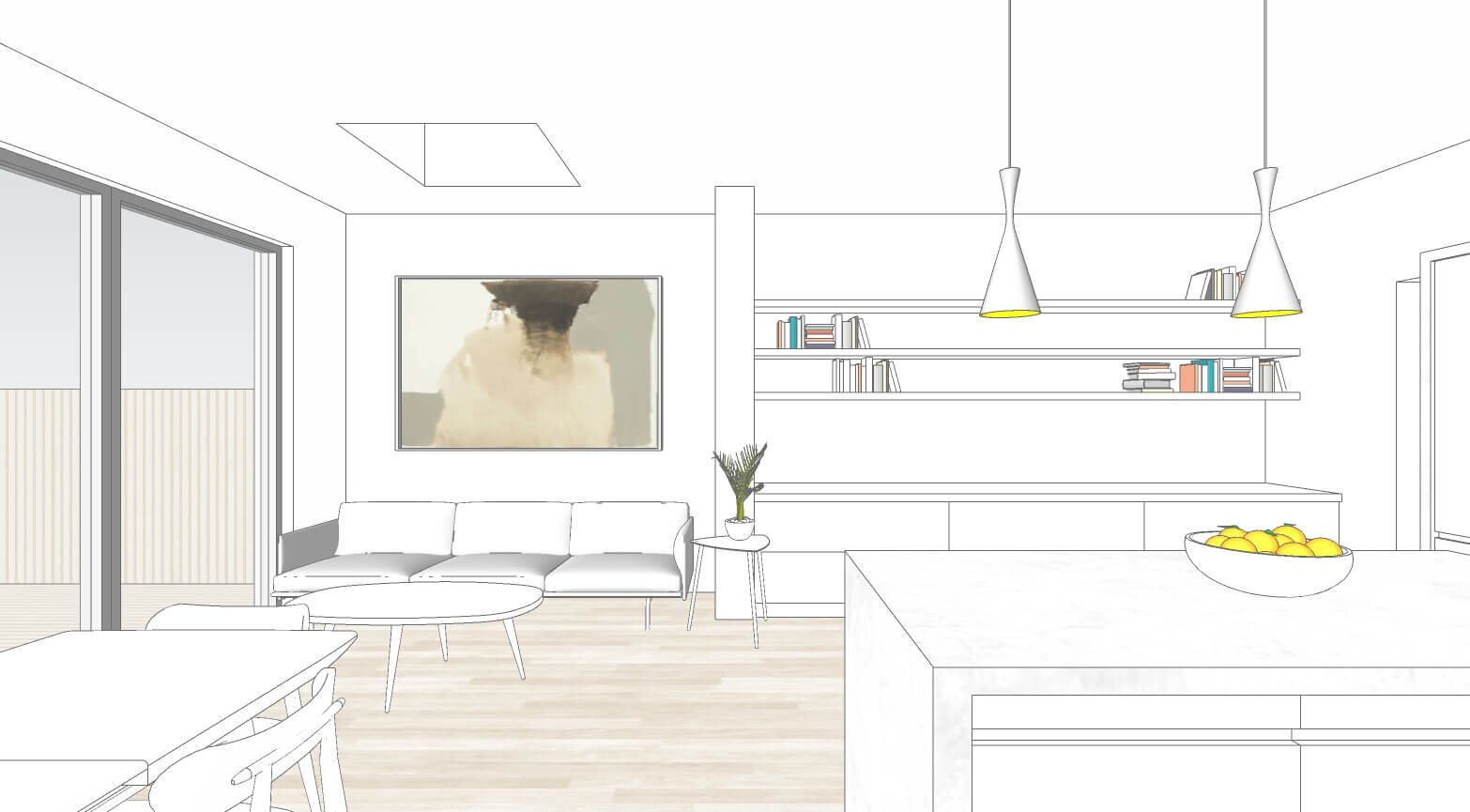
Another view of the preliminary design for a ground floor rear extension to a semi-detached house in Kingston. The intent is to integrate the existing window and chimney breast with the new kitchen, creating a low window seat that can be enjoyed by the family.

extension-kingston-open-space.jpg

In this view we tried to highlight the relationship between the kitchen area to the left and the open plan dining space to the right. The seamless ceiling transition helps to make these two spaces feel connected and cohesive from a design perspective.

The same floor will be used for both the existing floor plan and the new extension, leaving the two structural piers as the only demarcation between the original rear of the house and the extended portion.

An interesting feature of the existing house is the presence of a side window that is our intention to turn into a window seat that will feel like an extension of the kitchen itself.

Window seats are a fun feature that help creating some interesting corners that can relate to other elements of the room, in this specific case the kitchen island and breakfast bar right in front of it.

The kitchen, island, window seat and the extension’s window and skylights will all contribute to create an interesting space to be lived by our clients.

Daylight and luminance analysis for an extension in Kingston

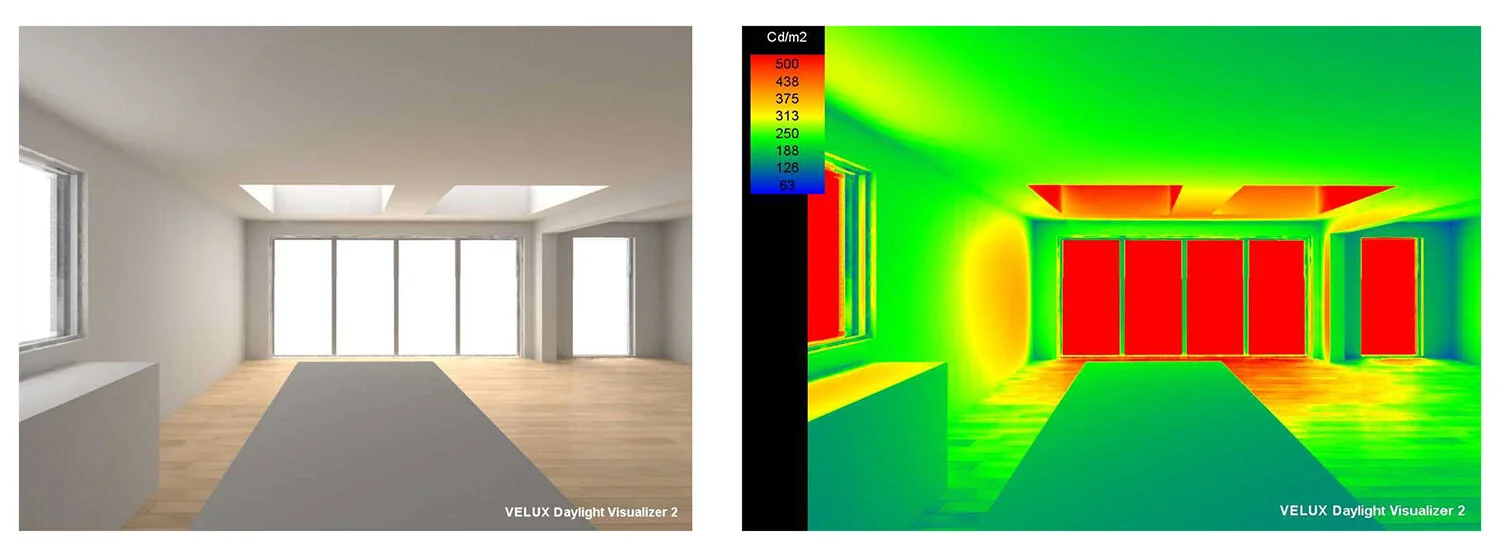
We regularly use analysis tools to predict the amount of daylight received in a space as a function of the openings size, location and moment of the year. In this view we are showing the predicted Luminance on the 21st of March at 12.00 for our new ground floor extension in Kingston.

Daylight+analysis_Page_2 (1).jpg

Daylight analysis tools offer to foresee the exact amount of daylight received by a determined space in several moments of the year. These tools are always very helpful in general, but they play a crucial role in our designs. By scrolling through our project images it is easy to see that daylight intake is a common thread, we are convinced that daylight within a household plays an huge factor in the health and well being of its inhabitants and we feel a duty as Architect to try and optimize this factor in all our projects.

In the case of this project for a rear extension in Kingston, we analysed the daylight intake with a configuration of a sliding door at the right, a generous window at the left and three skylights placed in the middle of the rear extension’s ceiling. With this type of diagram, it is very easy to see that the daylight will be very evenly distributed throughout the floor plan without being overwhelming (refer to the area in green).

Lighting design is a complex discipline, but we try to explain these metrics and parameters to the clients in a very straightforward way so they can understand the rational behind the dimension of the openings in their extensions.

These tools have become an essential part of our work at any stages of the design, especially at preliminary stages prior to submitting a planning application. We look forward to seeing this project finished and show this point with the final pictures.

Work in progress: Rear extension in Kingston

Another image of our new project for a rear extension in Kingston featuring an open space kitchen/living/dining

INTERNAL VIEWS3.jpg

This image highlights a very important design feature that is often overlooked, the seamless ceiling transition between the existing house and the new extension.

From a design perspective this is an ideal solution when we are dealing with flat ceilings with an identical head height. The lack of any beam or bulkhead separating the spaces creates the feeling of a cohesive space with one unobstructed ceiling. The other major advantage of this type of solution is that daylight coming from the skylights in the new extension does not get blocked by any obstructions at ceiling level. This guarantees optimal daylight distribution within the floor plan.

There are some structural implications with this type of solution that need to be assessed by qualified engineers and architects and discussed with he builder, however the end result is always wotlrth the effort. In the case of this project in Kingston the open plan will feel bright and spacious with a cohesive design that will give the impression of a very natural space that was always meant to be there.

We can’t wait to see this project finished and show how effective this solution can be through the final pictures. In the meantime you can see another project for a rear extension where a similar solution was adopted by clicking here.

A picture of the project in Wimbledon under construction can be seen here.

Work in progress: House extension in Kingston

First image of our new project for a rear extension in Kingston

kingston-extension-internal-view-01.jpg

Square One Architects have been appointed to redesign the rear extension of a large XIX century semi-detached house in Kingston.

The property in question was extended in 2003 by the previous owners however the clients were not happy with the overall design.

Their main complaint regarded the amount of daylight that they received within the ground floor of the property and the connection between the extension and the rest of the house. In fact, the existing extension was separated from the original rear of the property by a thick wall with two small openings causing the original rooms facing the back garden to be extremely dark.

This is very typical situation. Extending traditional properties without any consideration given to daylight intake always carries the potential risk of creating spaces that feel dark and separated.

The clients’ brief included the removal of the non-original extension and replacement with a new one that would allow a generous amount of daylight throughout the ground floor of the property. They also wanted to carry out some internal alterations that would allow to have a seamless connection between the existing spaces and the new extended section of the house.

The project also included moving the existing kitchen to the new open plan area, using the original kitchen space as a playroom.

As a practice we felt that we were the perfect match for this type of project given our expertise in residential design with a focus on the south west of London and our specialist expertise in lighting design.

The layout shown in the drawing above exemplifies our ideas for this project where the internal space formed by the existing house and the new extension feel like one.

A set of sliding doors, two large roof lights and a spectacular l-shaped window to the opposite corner will allow for daylight to be distributed throughout the floor plan.

Our new project for a house extension in Byfleet & New Haw

A pretty dramatic before and after image of the front our recent project for a detached house in Byfleet and New Haw

house-extension-byfleet-new-haw-front.jpg

The pictures above show the dramatic difference between the existing detached house in Byfleet and New Haw before and after the extension and refurbishment works.

When we first met the client in 2018, we found a property with lots of potential but very tired both externally and internally. The house needed a full refurbishment and several improvements were also necessary in order to maximize the use of internal spaces.

In the picture to the right our first-floor side extension can be seen to the left. The purpose of this extension was to add a new dressing area and en-suite bathroom with a window on the front of the house. Both the dressing room and en-suite have been designed to be directly connected to an existing bedroom that the clients decided to use as their master bedroom.

The project also included new rendering to the front, sides and rear of the property and the ground floor rear extension along with several internal alterations to create an open plan space at ground floor level.

It was a remarkably interesting project, with a proactive client who put a lot of stress on the importance of design.

We are incredibly happy with the result and final pictures of the standard property can be seen here.

When we went to site we also filmed a video showing the ground floor of the property. It can be visualized here.

Work in progress: Daylight analysis for one of our projects in Hampton

We usually determine the final dimension of doors and skylights using daylight analysis tools. These tools play a crucial role in our design process, allowing us to carefully assess and optimize the luminance levels on specific dates. For one of our ongoing projects in Hampton, we recently conducted a thorough analysis and the images below refer to a daylight simulation on March 21st at 12.00.

When it comes to predicting daylight levels, at Square One Architects, we rely on two key metrics: daylight factor and luminance. These metrics provide us with valuable insights, each with its own advantages and limitations. The daylight factor offers a straightforward snapshot of the projected average daylight levels, while luminance provides a more intricate analysis, taking into account factors such as orientation, the day of the year, and the time of day. By carefully cross-referencing these results, we can effectively communicate to our clients the reasons behind our optimized design choices for doors, windows, and skylights, tailored to their unique project requirements.

This particular project involves both a ground floor extension and a loft extension, posing unique challenges when it comes to daylighting. When it comes to the ground floor extension, it is of utmost importance to consider the predicted level of daylight in relation to the orientation of the building and the size of the glazed surfaces. Thankfully, in this case, the rear extension faces north, granting us the opportunity to incorporate generous glazed surfaces while minimizing the risk of overheating during the warmer summer months.

extension-hampton-daylight-analysis.jpg

Work in progress: rear and loft extension in Hampton

We want to show you a beautiful picture of our latest project in Hampton. It's an extension at the back and on the top floor of a house. The picture shows a modern and impressive design with a lot of attention to detail. In the picture, you can see a playroom, a dining area, and an open plan kitchen. The design makes the space flow smoothly, which is great for relaxing and socializing.

At Square One Architects, we take pride in being able to explain our design ideas clearly to our clients. We often use 3D modelling tools to help our clients understand and appreciate our designs. These tools allow our clients to experience their future homes in a virtual way. This advanced technique makes it easier for our clients to imagine their dream homes. With our expertise in 3D modelling, we make sure to include a lot of detail and make everything look realistic. This helps our clients form a strong connection with their imagined spaces.

3D modelling comes particularly handy following the planning stage when clients are expected to take important decisions on their projects, such as materials, kitchen design, lighting, and many more. Utilizing 3D modelling technology allows architects to present clients with a variety of options in quick succession, enabling them to visualize the different possibilities with ease and make well-informed decisions. The ability to present multiple designs efficiently not only saves time but also enhances collaboration between the architect and the client, ensuring that the final outcome meets the client's expectations and preferences. By harnessing the power of 3D modelling, architects can bring ideas to life, enabling clients to make informed choices and ultimately leading to the creation of stunning, functional spaces.

extension-hampton-internal-view-04.jpg